
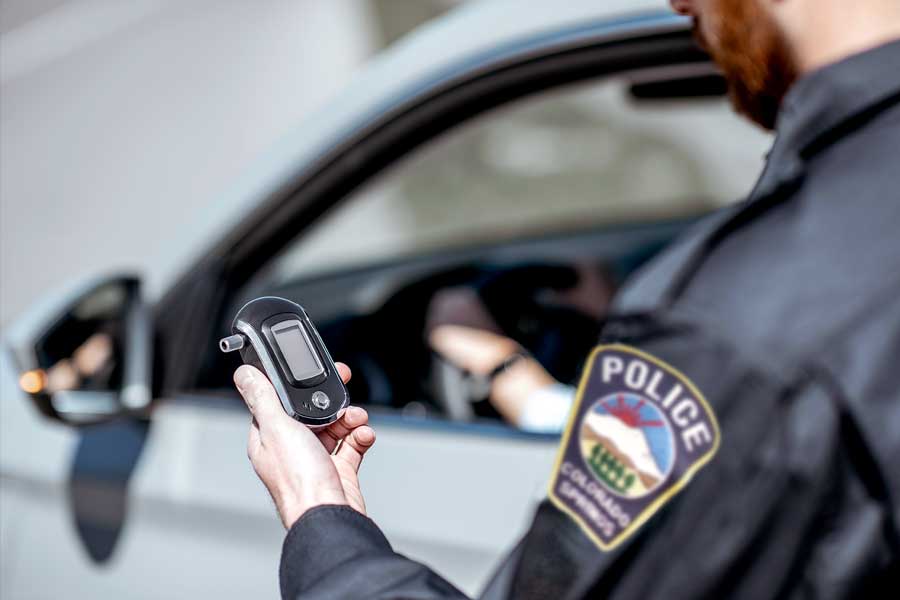
When someone is arrested for impaired driving in Colorado, the charge on the paperwork is not always what they expected. Colorado has multiple impaired driving offenses under C.R.S. § 42-4-1301, and the distinction between them is not just a matter of terminology. The specific charge determines the penalties you face, the effect on your license, and the defense strategy that makes sense for your case.
Here is what each charge actually means and how they differ from each other.
DUI: Driving Under the Influence
DUI is the most serious of Colorado’s impaired driving offenses. Under C.R.S. § 42-4-1301(1)(a), a person commits DUI when they are substantially incapable, either mentally or physically or both, of exercising clear judgment, sufficient physical control, or due care in the safe operation of a vehicle due to the consumption of alcohol, drugs, or a combination of both.
The key word is “substantially.” DUI requires a meaningful degree of impairment that compromises the driver’s ability to operate a vehicle safely. The charge is based on observed behavior and performance, and it does not require a specific BAC reading to be proved.
DUI Per Se is a related but distinct charge under C.R.S. § 42-4-1301(1)(b). A person commits DUI Per Se when a chemical test shows a BAC of 0.08% or higher, regardless of whether they actually appeared impaired. The BAC number alone is legally sufficient. A driver who tests at 0.08% or above can be convicted of DUI Per Se even if their driving seemed normal and the arresting officer observed no obvious signs of impairment.
Under Colorado law, a BAC of 0.08% or higher also creates a permissible inference that the driver was under the influence for purposes of a standard DUI charge. In practice, prosecutors often charge both DUI and DUI Per Se simultaneously when a chemical test is available. The jury can convict on either theory.
First-offense DUI penalties under C.R.S. § 42-4-1307(3) include five days to one year in county jail (the five-day minimum can be suspended if the defendant completes an alcohol evaluation and treatment program), a fine of $600 to $1,500, 48 to 96 hours of community service, up to two years of probation, and a nine-month driver’s license revocation. If the BAC was 0.20% or higher, a mandatory minimum of ten days in jail applies and cannot be suspended by the court.
DWAI: Driving While Ability Impaired
DWAI is a lesser offense than DUI. Under C.R.S. § 42-4-1301(1)(g), a person commits DWAI when they are affected by alcohol or drugs, or a combination of both, to the slightest degree so that they are less able than they ordinarily would have been to exercise clear judgment, sufficient physical control, or due care in the safe operation of a vehicle.
The phrase “slightest degree” is the critical distinction. Where DUI requires substantial impairment, DWAI requires only a slight reduction in the driver’s ordinary ability. This is a lower threshold and covers a wider range of conduct.
A BAC above 0.05% but below 0.08% creates a permissible inference of DWAI under C.R.S. § 42-4-1301(6)(a)(II). However, unlike DUI Per Se, there is no DWAI Per Se offense. A BAC in the 0.05% to 0.079% range creates an inference that the driver may have been impaired, but the prosecution must still prove actual impairment. A driver can also be charged with DWAI based on observed behavior alone, without any chemical test, if the officer has probable cause to believe the driver was impaired to the slightest degree.
DWAI is still a criminal offense in Colorado, not a traffic infraction. It goes on your permanent criminal record. It cannot be sealed or expunged.
First-offense DWAI penalties under C.R.S. § 42-4-1307(4) are lighter than DUI but still significant: two days to 180 days in county jail, a fine of $200 to $500, 24 to 48 hours of community service, and up to two years of probation. A first-offense DWAI does not trigger an automatic license revocation the way a DUI does. Instead, the DMV assesses eight points against the driver’s license. That said, accumulating points can eventually lead to a suspension depending on the driver’s overall record.
One important note: when a person has at least one prior DUI or DWAI conviction, the penalties for DUI, DUI Per Se, and DWAI become identical. The prior conviction eliminates the penalty distinction between the charges.
DUID: Driving Under the Influence of Drugs
DUID is not a separate statute from DUI. It falls under the same C.R.S. § 42-4-1301 framework and carries the same penalties as DUI. The distinction is the substance involved. DUID applies when a driver is substantially incapable of safely operating a vehicle due to the influence of drugs rather than alcohol. Those drugs can be illegal substances, marijuana, prescription medications, or over-the-counter drugs — anything that impairs the driver’s ability.
Colorado does not have a per se BAC equivalent for most drugs. The exception is marijuana. Under C.R.S. § 42-4-1301(6)(a)(IV), a THC concentration of five nanograms or more of delta-9-tetrahydrocannabinol per milliliter of whole blood creates a permissible inference that the driver was under the influence. This is not a per se offense, however. The inference can be rebutted. A driver who tests above five nanograms of THC can present evidence that they were not actually impaired, and a jury can accept that argument.
The five-nanogram inference has been controversial since Colorado legalized recreational marijuana in 2012. Regular cannabis users often maintain THC blood levels above five nanograms even when they are not acutely impaired. Officers also rely heavily on Drug Recognition Expert (DRE) evaluations in DUID cases, which involve a structured physical and behavioral examination designed to identify drug impairment. DRE testimony is admissible in Colorado courts but is subject to cross-examination and challenge.
For prescription medications, there is no numerical threshold at all. A driver who takes a legally prescribed medication and becomes impaired can be charged with DUID based entirely on observed impairment, without any chemical test result. The prescription itself is not a defense.
The BAC Thresholds at a Glance
Understanding where the lines fall on the BAC scale helps clarify which charge applies and what additional consequences may be triggered:
| BAC Level | Inference or Designation |
|---|---|
| 0.05% or below | Rebuttable presumption of non-impairment (alcohol only) |
| Above 0.05% to below 0.08% | Permissible inference of DWAI |
| 0.08% or above | Inference of DUI; DUI Per Se applies |
| 0.15% or above | Persistent Drunk Driver (PDD) designation |
| 0.20% or above | Mandatory 10-day jail minimum (cannot be suspended) |
The Persistent Drunk Driver designation under C.R.S. § 42-1-102(68.5) deserves specific attention. A driver is designated a PDD if their BAC is 0.15% or higher, if they refuse a chemical test, or if they have multiple prior alcohol-related driving convictions or revocations. The PDD designation applies even on a first offense if the BAC is 0.15% or above. It triggers mandatory installation of an ignition interlock device for at least two years and mandatory completion of a Level II alcohol education and treatment program.
The “Actual Physical Control” Rule
One aspect of Colorado’s impaired driving laws that surprises many people: you do not have to be driving a moving vehicle to be charged with DUI, DWAI, or DUID. Under C.R.S. § 42-4-1301, the offense covers both driving and being in “actual physical control” of a vehicle.
In People v. Swain, 959 P.2d 426 (Colo. 1998), the Colorado Supreme Court upheld a DUI conviction where the driver was asleep in the front seat of a parked truck with the keys in the ignition and the radio on. The engine was not running, and the vehicle was not moving. The court found that the defendant was in actual physical control based on his position in the driver’s seat with access to the ignition.
This matters practically. Sleeping in your car to sober up after drinking, with the keys accessible, can result in a DUI arrest in Colorado even without ever starting the engine or moving the vehicle.
DWAI as a Lesser Included Offense
DWAI is what Colorado law calls a lesser included offense of DUI. Under C.R.S. § 42-4-1301(8), in any case where DUI is charged, the jury can return a verdict of guilty on DWAI even if the evidence does not support the full DUI charge. A defense that successfully argues against DUI does not automatically result in acquittal — the jury can still convict on DWAI if the evidence supports the lesser level of impairment.
This structure affects plea negotiation as well. Prosecutors sometimes offer to reduce a DUI charge to DWAI as part of a plea agreement, which results in lower penalties and no automatic license revocation for a first offense. Whether that offer makes sense depends heavily on the specific facts of the case, the strength of the evidence, and the defendant’s prior record.
The Permanent Record Consequence
All three offenses, DUI, DUI Per Se, DWAI, and DUID, result in a permanent criminal conviction in Colorado. Under C.R.S. § 24-72-706, all impaired driving convictions are specifically excluded from Colorado’s record sealing statutes. There is no waiting period after which the conviction can be hidden from background checks. There is no expungement available for adults. The conviction stays on both the criminal record and the driving record for life, and it counts as a prior conviction forever for purposes of enhancing future charges.
It is worth noting that this exclusion applies to convictions. If your case is dismissed or you are acquitted at trial, the arrest record remains eligible for sealing under Colorado’s standard sealing procedures. That distinction is one of the practical reasons fighting a charge rather than accepting a plea can matter long after the courtroom proceedings are over.
Why the Charge You Face Matters
The difference between a DUI and a DWAI is not just about immediate penalties. It determines whether your license is automatically revoked, whether the PDD designation applies, how your record reads on future background checks, and how a future DUI or DWAI charge will be treated in terms of repeat offense enhancement. A charge that looks minor in the moment can have consequences that last decades.
If you have been charged with DUI, DWAI, or DUID in El Paso County, understanding exactly what you are facing is the first step. At Boal Law Firm, PC, Brian Boal is a former Deputy District Attorney who handled impaired driving cases from the prosecution side before representing defendants in Colorado Springs. Call (719) 203-6339 to schedule a consultation.